
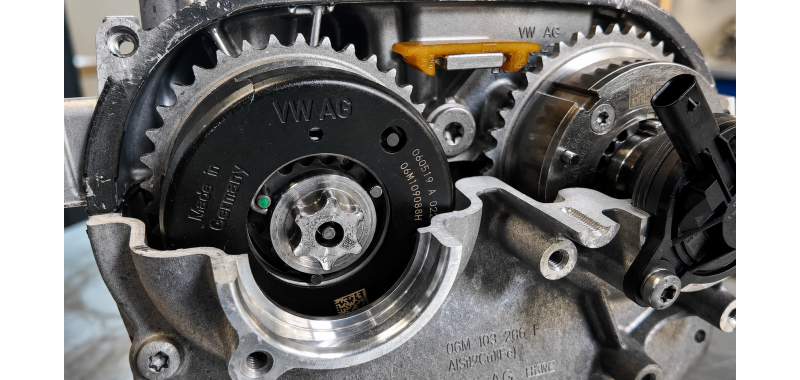
Audi and Porsche EA839 and EA825 engines are among the most advanced powerplants used across the Volkswagen Group. The EA839 family mainly includes the 2.9L and 3.0L V6 TFSI engines, while the EA825 family includes the 4.0L V8 TFSI engines.
The EA825 was developed jointly by Audi and Porsche, and its design is based on solutions previously used in the EA839 family. Both engine families use a similar timing drive layout and four hydraulic cam phasers – one for each intake and exhaust camshaft.
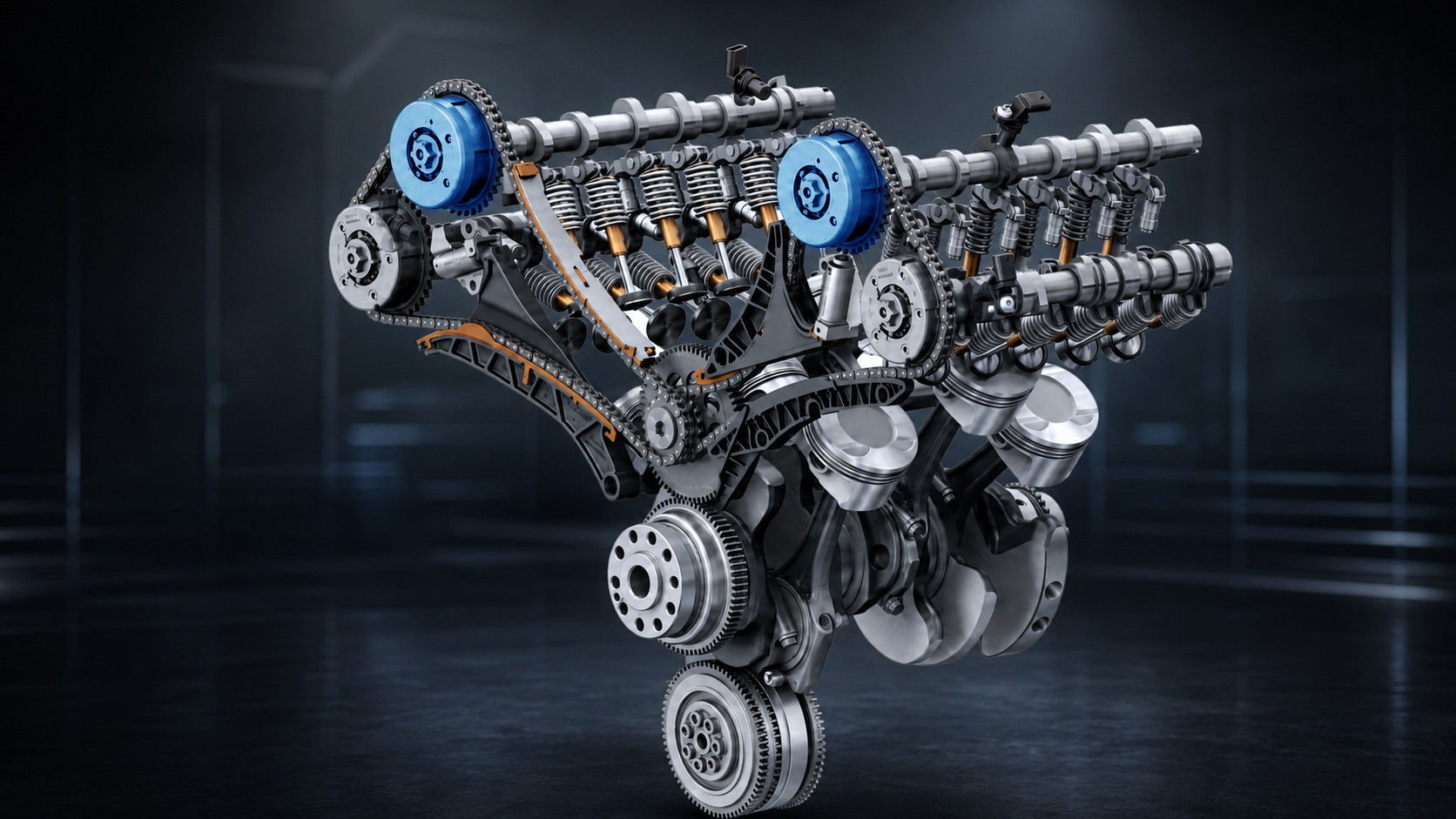
The variable valve timing system itself is advanced and helps improve the torque curve, engine response, fuel economy and emissions. However, the material used for the original timing sprockets has become a serious weak point.
The OEM cam phasers use aluminum timing sprockets. Based on our inspections and material testing, these sprockets may flake, chip and release aluminum debris into the engine lubrication system.
In this article, we explain:
- how the EA839 and EA825 cam phasers work,
- who manufactured the original camshaft adjusters,
- why the aluminum timing sprockets may fail,
- whether the newer 06M109087K and 06M109088K revisions were actually improved,
- why aluminum debris in the engine oil can be dangerous,
- how the redesigned MEHENKER cam phasers differ from the OEM parts,
- and why the camshaft VVT sealing rings should also be replaced during the repair.
Watch our video about the EA839 and EA825 aluminum sprocket problem
In our video, we show the original cam phasers used in Audi and Porsche EA839 and EA825 engines. We explain how they work, show the wear found on the aluminum timing sprockets and compare the OEM design with the redesigned MEHENKER cam phasers equipped with hardened steel sprockets.
We also compare the materials used in older and newer OEM revisions and explain why a new part-number suffix does not necessarily mean that the main design weakness has been eliminated.
The original VVT system is technically advanced, but its weak point is the material used for the sprockets that operate directly against the timing chain.
Which engines use these cam phasers?
This cam phaser design is used in the following gasoline engines:
- 2.9L V6 TFSI EA839,
- 3.0L V6 TFSI EA839.
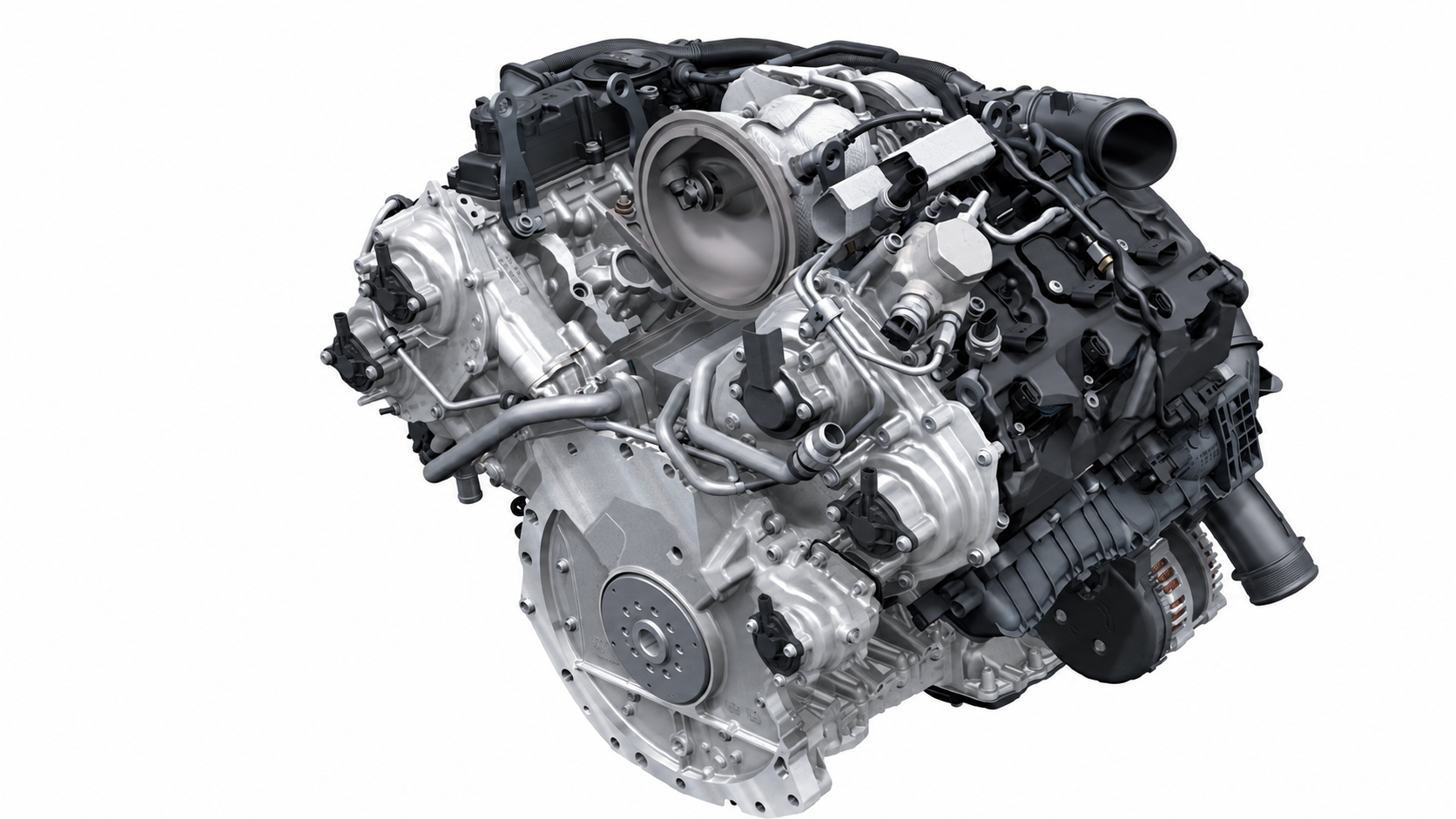
- 4.0L V8 TFSI EA825.
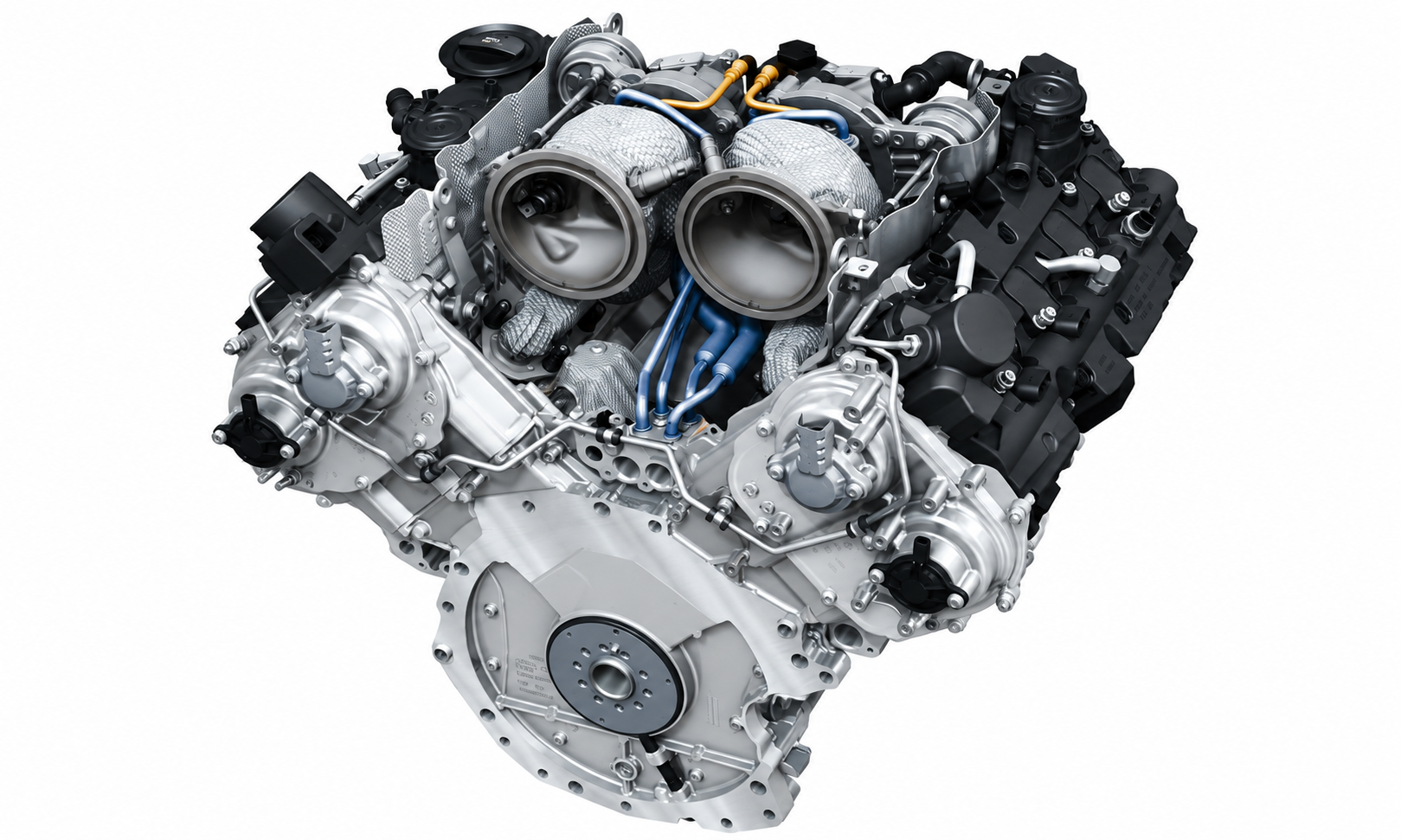
These engines are used in various versions of the Audi S4, S5, RS4, RS5, S6, S7, A6, A7, A8, SQ5, Q7 and Q8, as well as selected Porsche Panamera, Cayenne and Macan models.
The application list is extensive. Always confirm compatibility using the OEM part number, engine code or vehicle identification number before ordering.
Who manufactures the original cam phasers?
According to the markings found on the parts we inspected, the original cam phasers were manufactured by the German company Hilite, previously known as Hydraulik-Ring.
Hydraulik-Ring changed its name to Hilite in 2002. The company has specialized for many years in variable valve timing systems, oil control valves and other hydraulic engine components.
Hilite developed systems used in engines such as the BMW N52 and S55, Volkswagen VR6, W8 and W12, as well as various Porsche flat-six and V8 engines. These systems continuously adjust the intake and exhaust camshafts according to engine load, RPM and operating temperature.
The basic cam phaser design is technically very good. The problem is not the hydraulic operating principle, but the material used for the sprockets that operate against the steel timing chain.
How do the EA839 and EA825 cam phasers work?
The EA839 and EA825 engines use hydraulic cam phasers on all camshafts. Engine oil is directed into separate internal chambers, where oil pressure rotates the rotor connected to the camshaft relative to the sprocket driven by the timing chain.
The adjustment range is:
- 50 degrees of crankshaft rotation,
- which equals 25 degrees of camshaft rotation.
Audi technical documentation describes the cam phasers as continuously variable. At idle and under light load, the engine control unit normally keeps them close to their base positions, so the actual adjustment may be very small. However, the system is not mechanically switched off and can make corrections outside high-load operation.
After the engine is shut down, the phasers are locked in defined positions:
- the intake cam phasers are locked in the retarded position,
- the exhaust cam phasers are locked in the advanced position.
The exhaust cam phasers also use a return spring that helps move the internal rotor into the correct position before the locking mechanism engages.
During active camshaft adjustment:
- the intake camshafts are advanced, meaning that they are rotated in the engine’s direction of rotation.
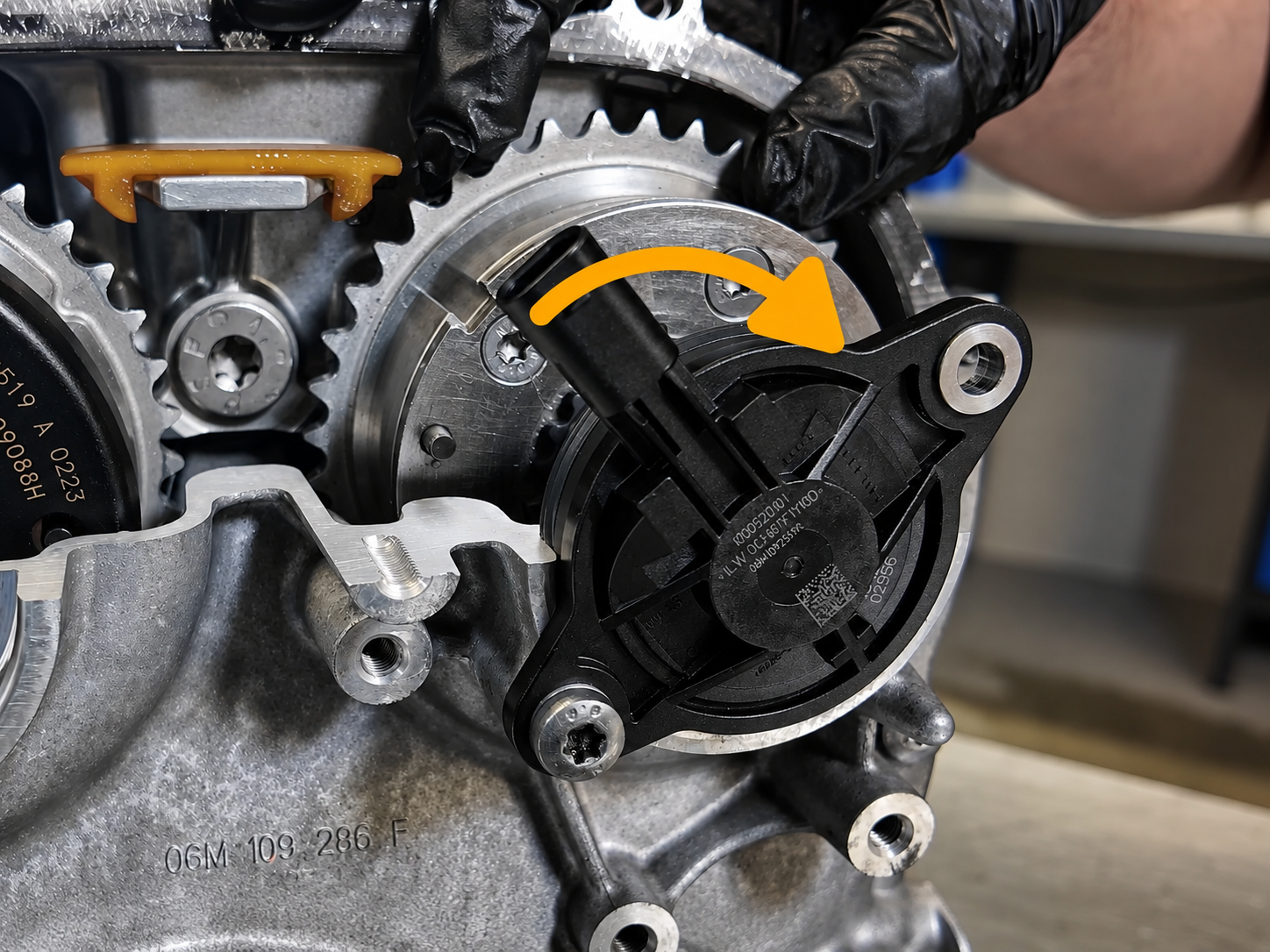
- the exhaust camshafts are retarded, meaning that they are moved in the opposite direction.
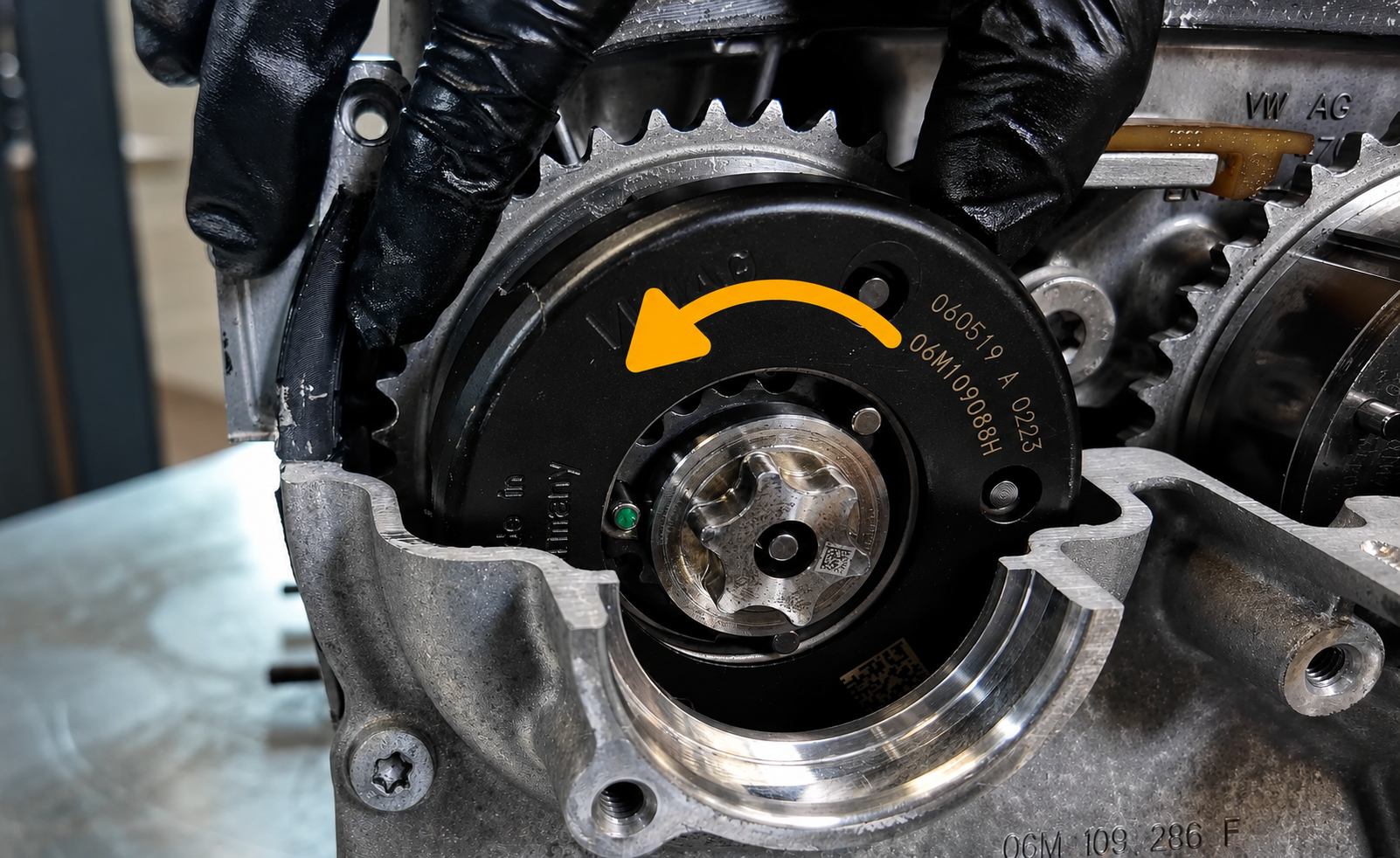
This is a simplified description of the direction of adjustment. The actual commanded angle is continuously calculated by the engine control unit according to current operating conditions.
Why do these engines use variable valve timing?
A fixed camshaft position is always a compromise. A position that works well at low RPM may not be ideal at high RPM or under heavy load.
Hydraulic cam phasers continuously change the opening and closing timing of the intake and exhaust valves. This helps:
- increase torque at low and medium RPM,
- improve engine response and drivability,
- improve cylinder filling under high load,
- create a broader and more useful torque curve,
- reduce pumping losses,
- provide internal exhaust gas recirculation,
- reduce fuel consumption,
- and lower exhaust emissions.
Correctly operating cam phasers therefore have a major effect on engine performance. Worn sprockets or excessive internal oil leakage can reduce the accuracy and stability of the entire VVT system.
EA839 and EA825 cam phaser OEM part numbers
Several OEM revisions are used in Audi and Porsche applications. The F, H, J, K and P suffixes identify later production revisions.
Intake cam phaser part numbers
- 06M109087F,
- 06M109087H,
- 06M109087J,
- 06M109087K,
- 06M109087P,
- 9A7109087,
- PAC109087.
Exhaust cam phaser part numbers
- 06M109088F,
- 06M109088H,
- 06M109088J,
- 06M109088K,
- 06M109088P,
- 9A7109088,
- PAC109088.
Part numbers ending in 087 are used for the intake cam phasers, while numbers ending in 088 identify the exhaust cam phasers.
The aluminum timing sprocket problem
The original cam phasers use aluminum sprockets that operate directly against a steel iwis roller timing chain.
According to material testing performed by MEHENKER, the aluminum used in the cam phasers we inspected does not show evidence of heat treatment that would significantly improve its surface hardness or wear resistance. The measured hardness was approximately 140 HB.
On used OEM cam phasers, we have observed:
- flaking of the working surfaces of the sprocket teeth,
- chipping and loss of aluminum material,
- rounded and deformed tooth edges,
- uneven timing-chain contact patterns,
- and localized material loss.
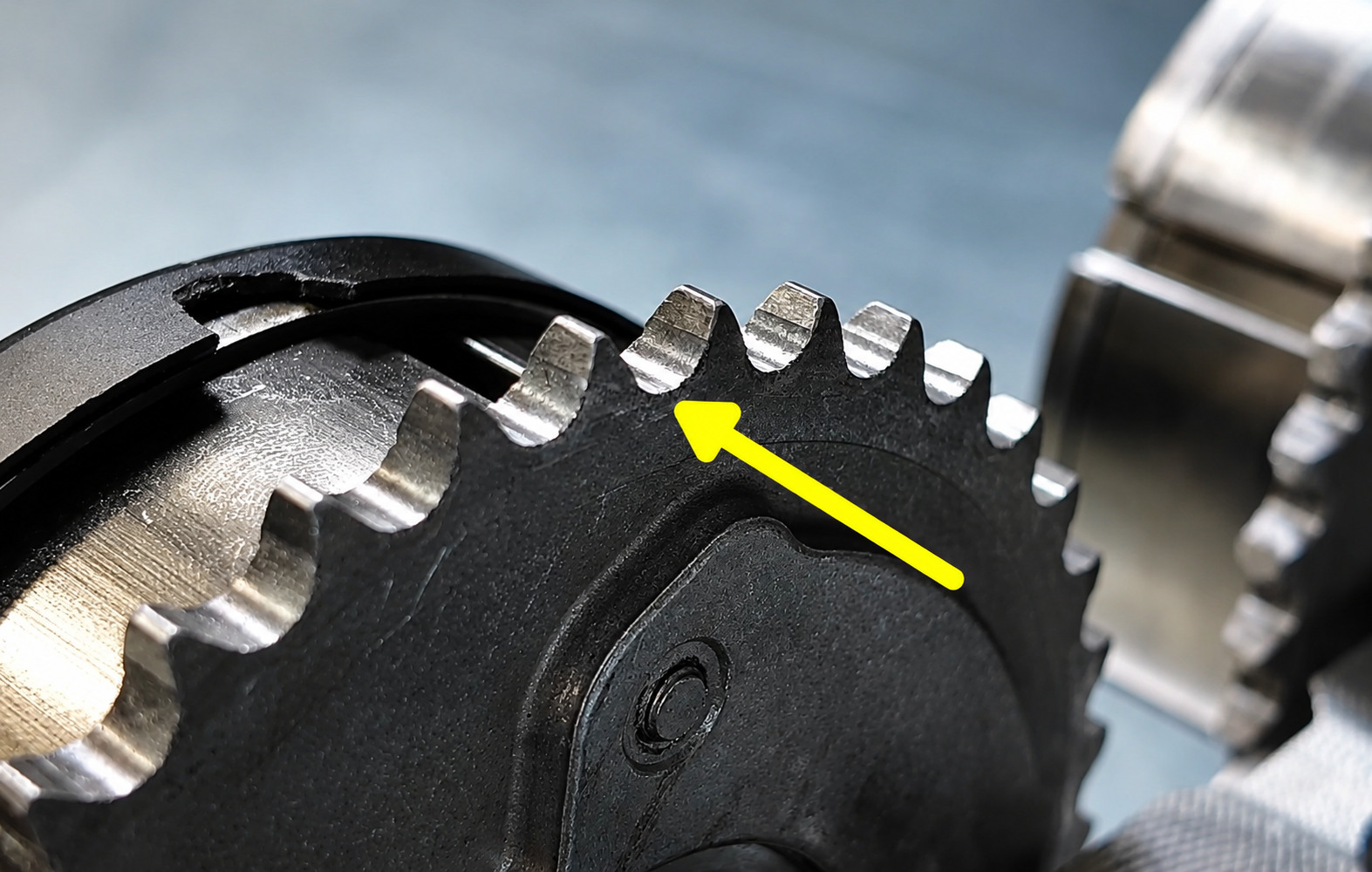
Some of the damage may indicate more than normal operating wear. Local material inconsistencies or manufacturing defects may also contribute to the way the aluminum surface flakes and breaks away.
Aluminum helps reduce component weight, but the timing sprocket must continuously carry alternating loads generated by the valvetrain. It also operates against a much harder steel chain at high temperature and under constantly changing loads.
Were the 06M109087K and 06M109088K cam phasers improved?
It is sometimes claimed that the newer:
- 06M109087K,
- 06M109088K
revisions were improved and no longer have the sprocket problem found in earlier versions.
However, according to material analysis performed by MEHENKER, the K revision did not replace the aluminum timing sprocket with a steel part or with a significantly harder aluminum material.
The K-revision cam phasers we inspected still used aluminum sprockets with material properties very similar to the earlier versions.
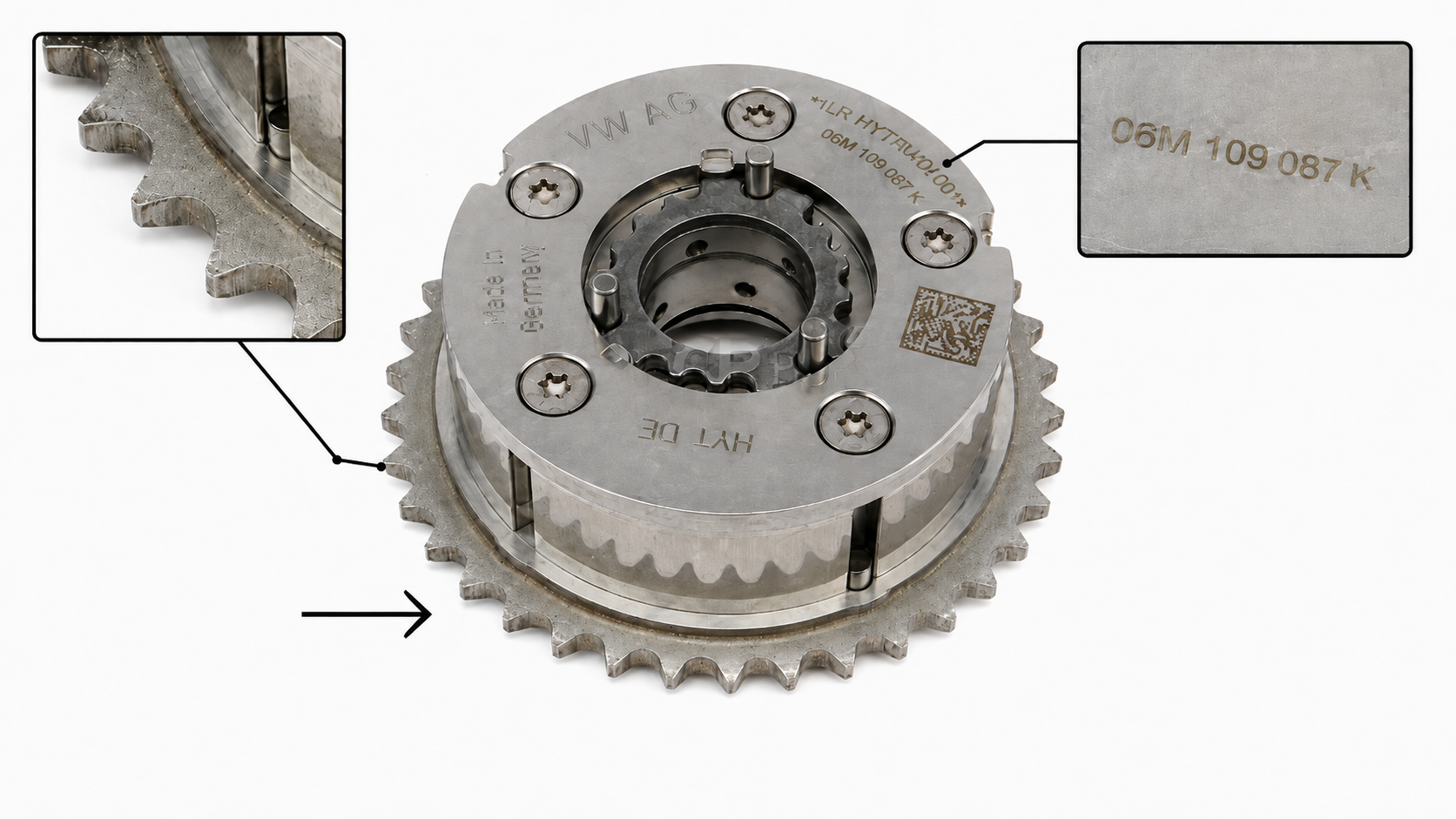
This means that the main design feature remained unchanged. A newer OEM part-number revision does not necessarily mean that the aluminum sprocket wear problem has been eliminated.
Aluminum debris in the engine oil
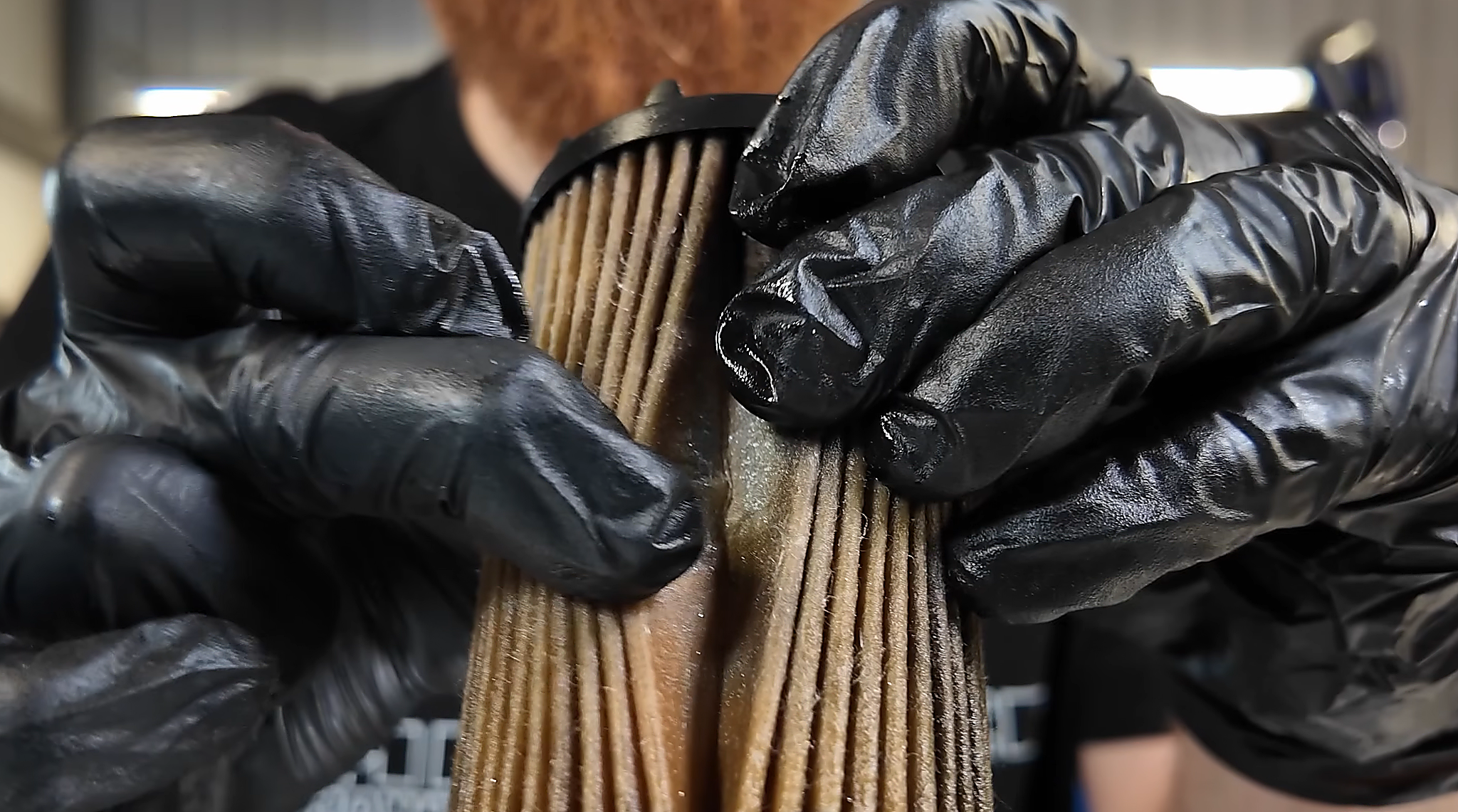
Material that flakes or chips away from the timing sprockets enters the engine oil. Larger particles may be captured by the oil filter, while smaller particles may continue circulating through the lubrication system.
In these engines, the oil system supplies components including:
- the engine oil pump,
- timing chain tensioners,
- cam phasers,
- VVT oil control valves,
- camshaft bearings and journals,
- hydraulic valvetrain components,
- turbochargers,
- crankshaft main bearings and connecting-rod bearings.
Metal particles in the oil may contribute to:
- accelerated oil-pump wear,
- contamination of the VVT oil control valves,
- reduced timing chain tensioner performance,
- wear of precision hydraulic surfaces,
- contamination of narrow oil passages,
- and accelerated wear of other oil-lubricated engine components.
This does not mean that every small aluminum particle will immediately destroy the oil pump or engine bearings. The problem is that a damaged sprocket can become a continuous source of debris circulating through the lubrication system.
MEHENKER cam phasers with hardened steel sprockets
When developing the MEHENKER cam phasers, we did not simply copy the original design. The complete mechanism was redesigned and rebuilt from the ground up.
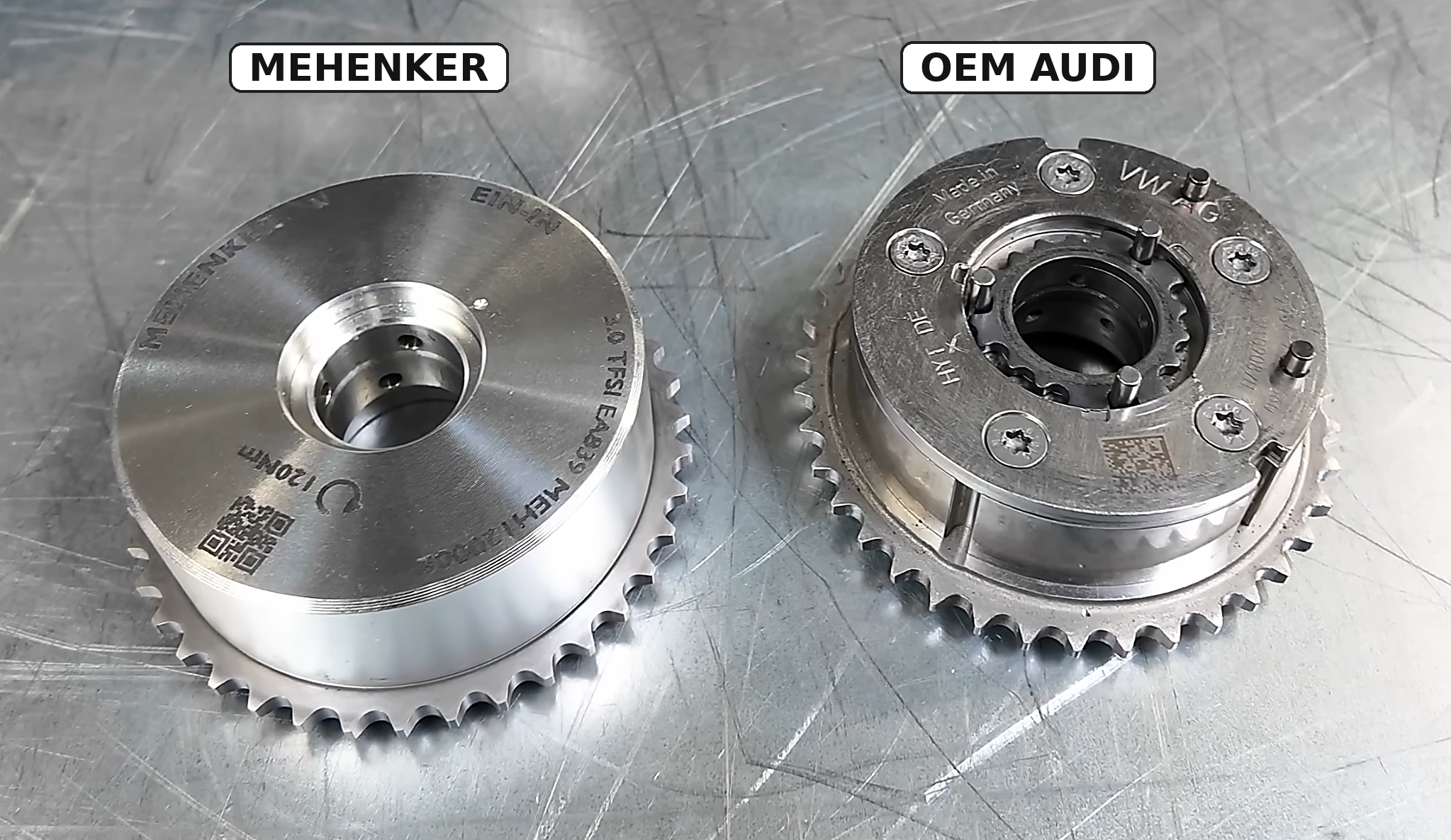
The main changes include:
- hardened steel timing sprockets instead of aluminum sprockets,
- sprocket teeth hardened to more than 50 HRC,
- larger and stronger internal components,
- a reinforced locking mechanism,
- modified hydraulic chamber geometry,
- improved internal oil sealing,
- and individual testing of every cam phaser using hot engine oil.
The hardened steel sprocket is much more resistant to operating against a steel timing chain. It does not wear in the same way as the aluminum sprockets we inspected and cannot become a source of aluminum debris in the oil.
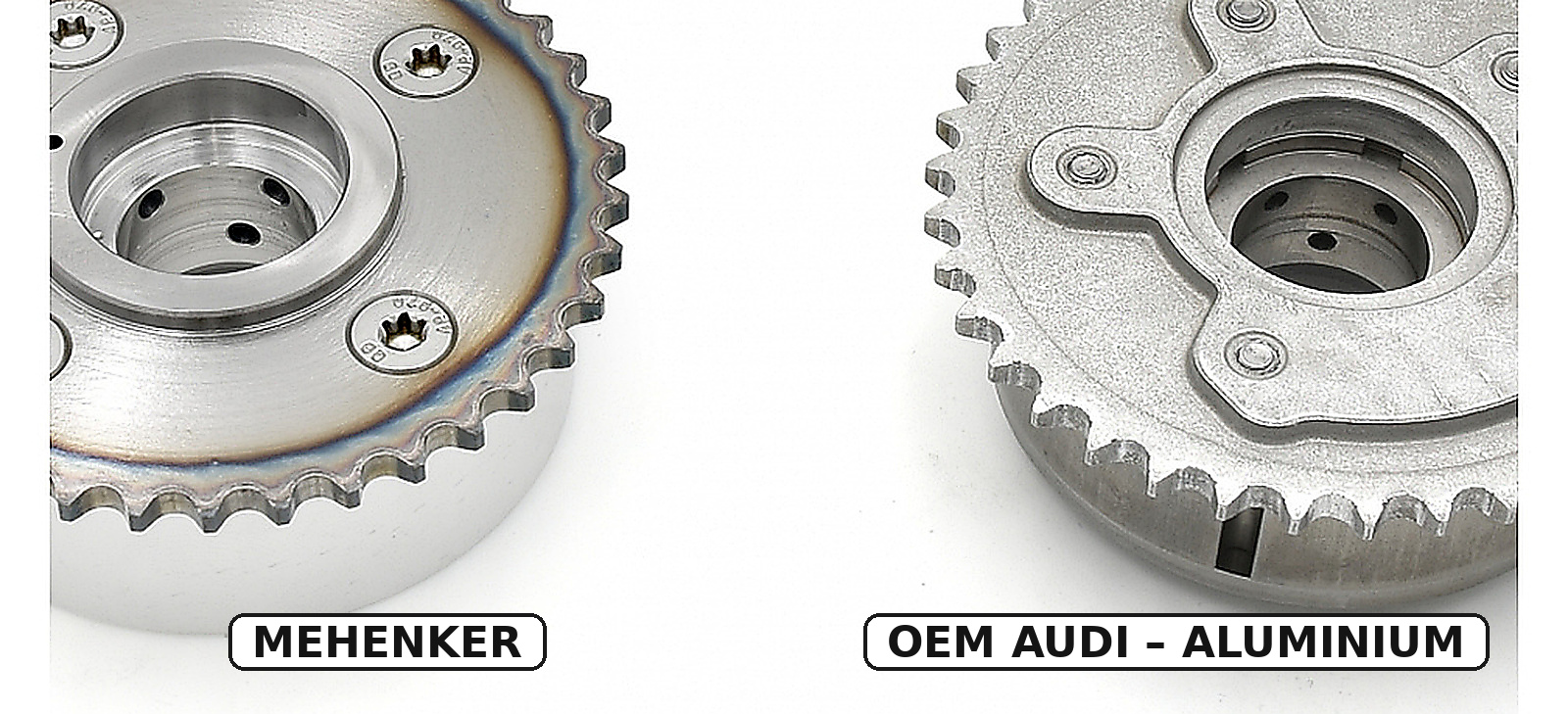
When the goal of the repair is to completely eliminate the aluminum timing sprocket, the complete MEHENKER cam phasers provide a real alternative to installing another OEM revision with a similar basic design.
Approximately 10% more cam phasing torque
The MEHENKER cam phasers have a larger effective hydraulic working area. According to our measurements, this provides approximately 10% more cam phasing torque at a comparable engine oil pressure.
This does not mean that the engine produces 10% more crankshaft torque. It refers only to the internal torque generated by the cam phaser to rotate the camshaft relative to the timing sprocket.
The higher cam phasing torque provides:
- more available force during camshaft adjustment,
- more reliable operation against valvetrain resistance,
- more stable adjustment with hot, low-viscosity engine oil,
- and more positive movement toward the commanded camshaft angle.
Improved internal hydraulic sealing
Inside a cam phaser, engine oil must be directed into the correct chamber to generate torque and rotate the internal rotor. Excessive internal leakage allows some of the oil flow to escape between chambers instead of producing useful movement.
A worn or internally leaking cam phaser may:
- reach the commanded angle more slowly,
- hold the camshaft position less consistently,
- show a larger difference between commanded and actual camshaft angle,
- and trigger variable valve timing performance faults.
MEHENKER cam phasers have improved internal sealing. This allows the system to use the available engine oil pressure more efficiently and reduces oil-flow losses between the hydraulic chambers.
This may improve the speed and stability of the VVT system response. However, overall engine response also depends on oil pressure, oil control valves, engine condition, software calibration and the condition of the remaining timing-system components.
Steel timing sprockets without increased cam phaser weight
Despite using a much stronger hardened steel timing sprocket, the MEHENKER cam phasers are lighter than the original parts.
This was achieved by completely redesigning and optimizing the individual components of the cam phaser.
| Cam phaser | Weight |
|---|---|
| MEHENKER – intake or exhaust side | 612 g |
| OEM intake cam phaser | 670 g |
| OEM exhaust cam phaser | 733 g |
The MEHENKER cam phaser is:
- 58 g, or approximately 8.7%, lighter than the OEM intake cam phaser,
- 121 g, or approximately 16.5%, lighter than the OEM exhaust cam phaser.
Compared with the average weight of both OEM versions, the MEHENKER cam phaser is approximately 13% lighter.
The effect of this weight difference on the rotational inertia of the complete system is small. The cam phasers have a relatively small diameter, and the camshafts rotate at half crankshaft speed.
The main advantage is therefore not a major reduction in rotational inertia. The important point is that using a hardened steel sprocket did not increase the total weight of the cam phaser. We significantly improved the durability of the most heavily loaded component while keeping the complete assembly lighter than the OEM part.
Camshaft VVT sealing rings
When replacing the cam phasers, the camshaft VVT sealing rings should also be inspected.
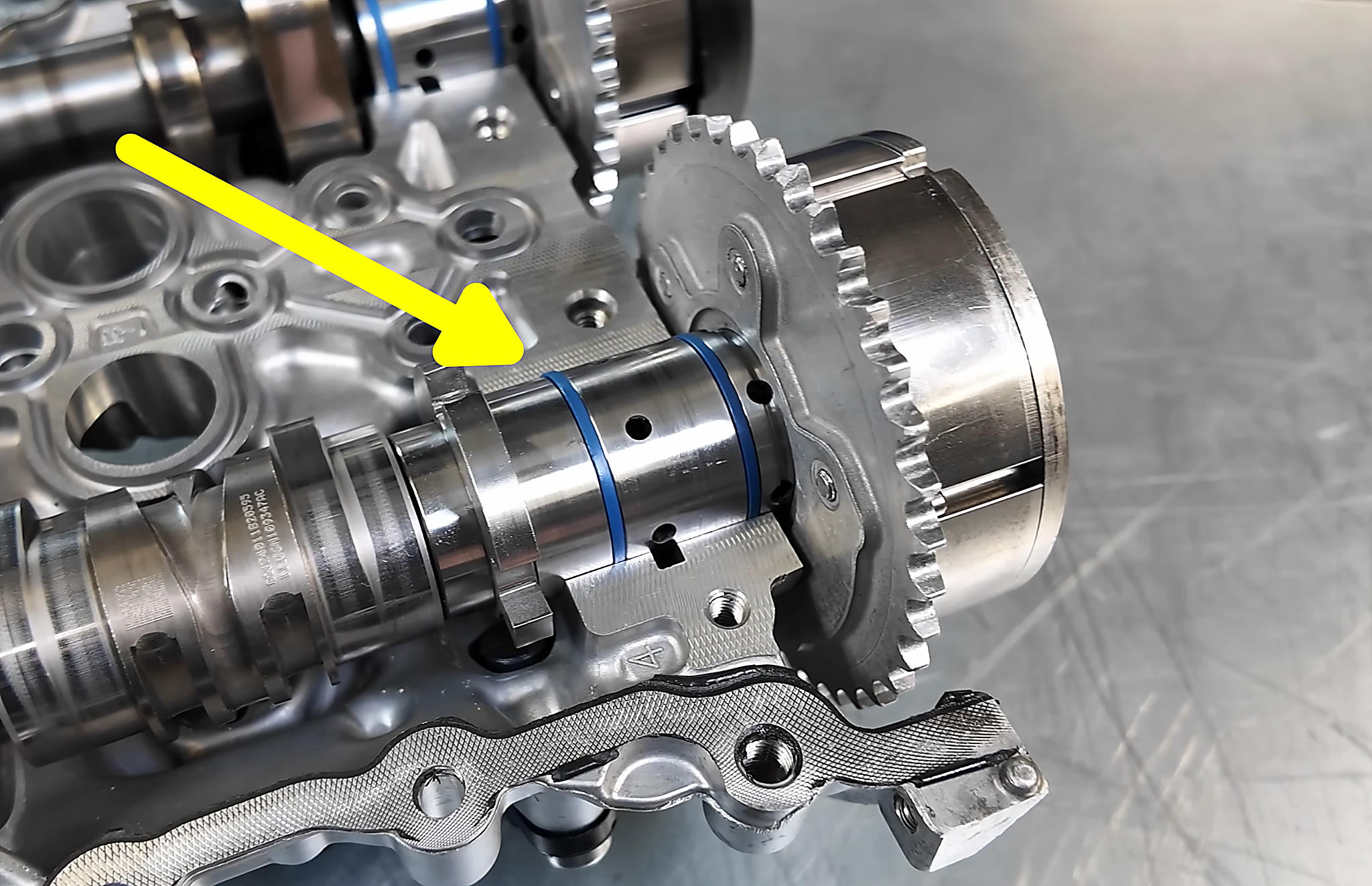
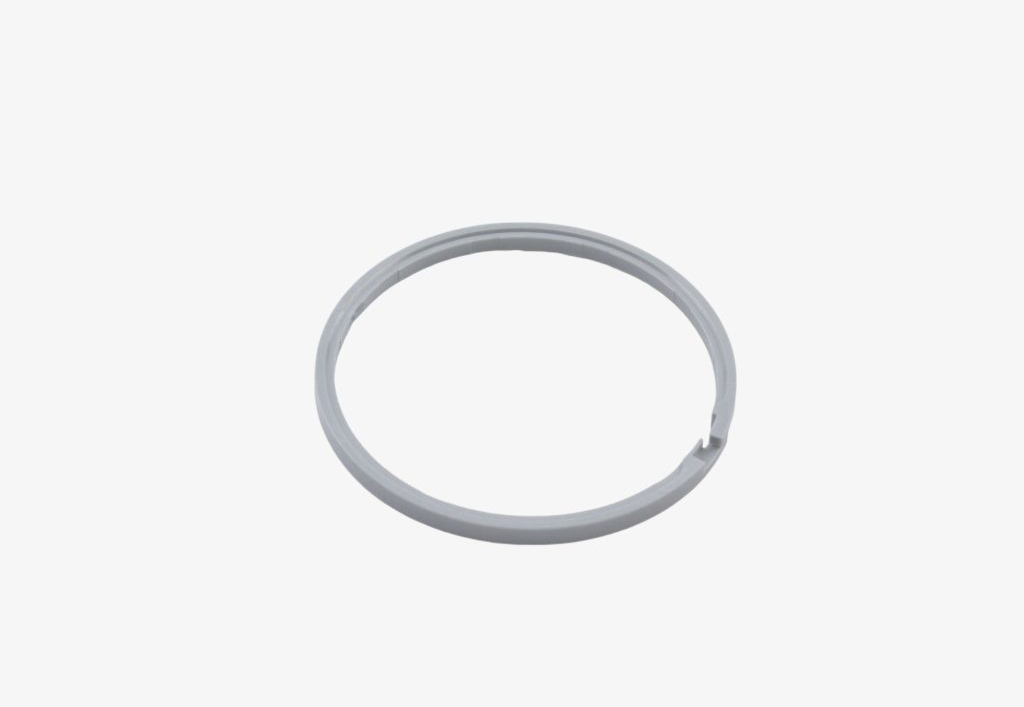
These rings separate the oil passages that feed the individual hydraulic chambers inside the cam phasers. Worn sealing rings may cause oil-pressure loss and internal leakage between the passages.
Possible symptoms of worn camshaft sealing rings include:
- slower cam phaser response,
- difficulty reaching the commanded camshaft angle,
- unstable camshaft adjustment,
- camshaft timing or VVT performance faults,
- and excessive leakage in the cam phaser oil circuit.
The original sealing rings are made from a relatively soft material that may wear and lose its sealing ability over time.
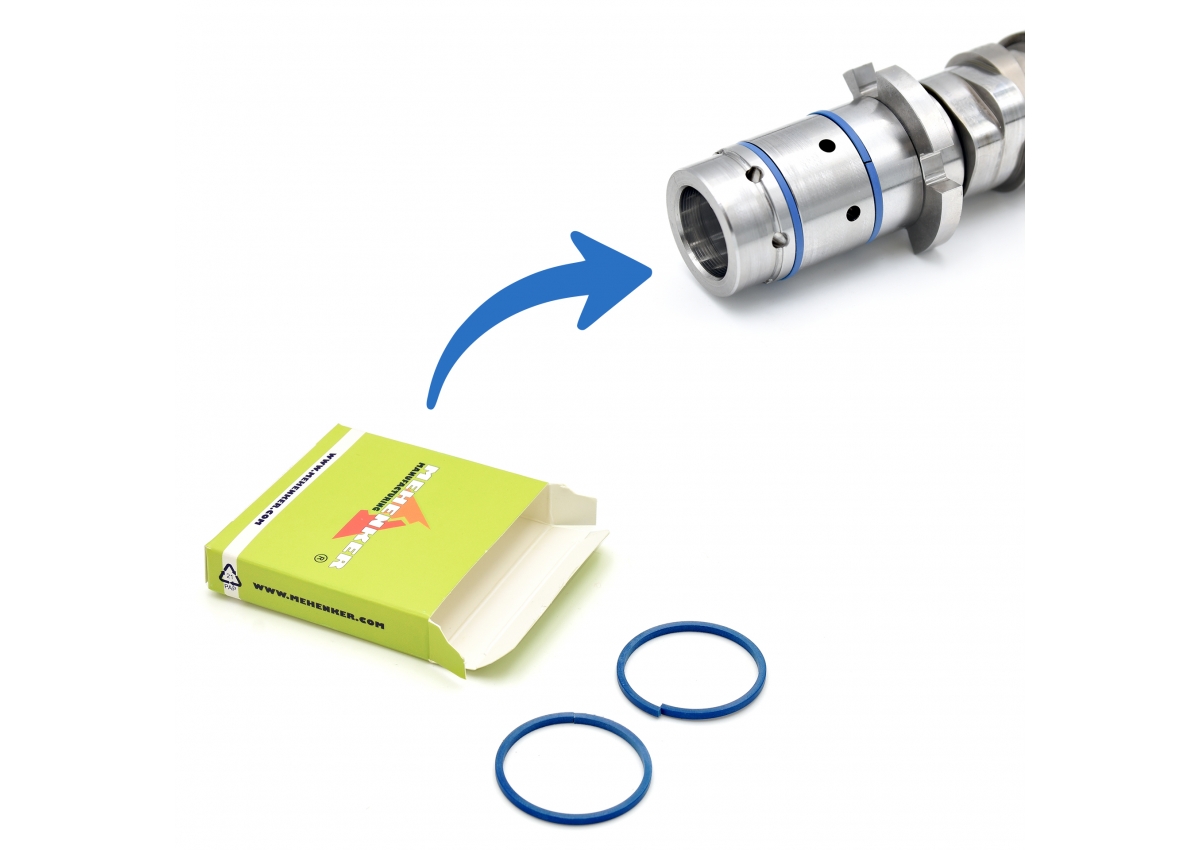
MEHENKER sealing rings are made from a special blue composite material with a low coefficient of friction.
They provide:
- low friction against the mating surface,
- high resistance to wear,
- stable sealing between the individual oil passages,
- correct oil supply to the cam phasers,
- and longer, more stable VVT operation.
For this reason, we recommend inspecting and replacing the camshaft sealing rings whenever new cam phasers are installed.
MEHENKER cam phasers for Audi and Porsche EA839 and EA825 engines
The MEHENKER set includes four complete cam phasers:
- two intake cam phasers,
- two exhaust cam phasers.
The set is designed for:
- Audi and Porsche 2.9L V6 TFSI EA839 engines,
- Audi and Porsche 3.0L V6 TFSI EA839 engines,
- Audi and Porsche 4.0L V8 TFSI EA825 engines.
MEHENKER – set of four EA839 / EA825 cam phasers
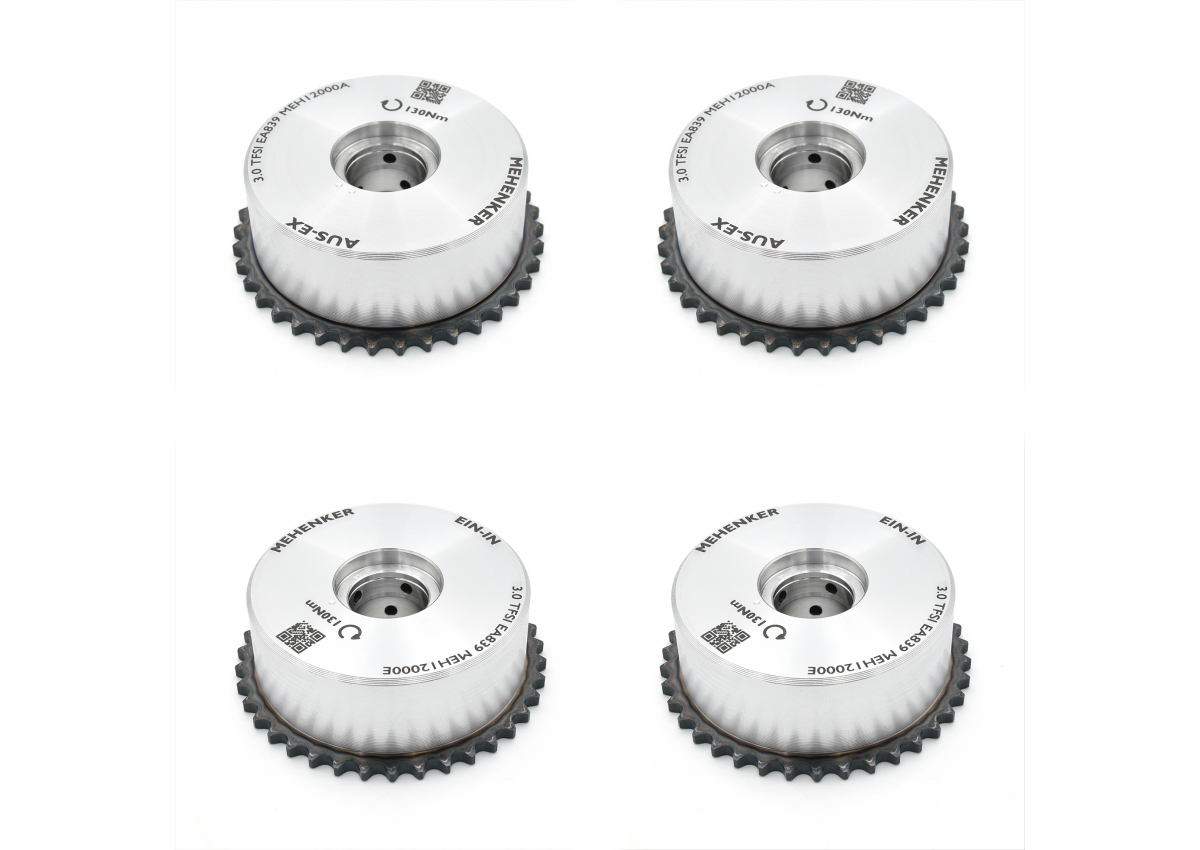
Completely redesigned cam phasers with hardened steel sprockets, a reinforced locking mechanism and improved internal hydraulic sealing.
- complete set of four cam phasers,
- hardened steel sprockets with tooth hardness above 50 HRC,
- no aluminum sprocket teeth operating against the timing chain,
- approximately 10% more cam phasing torque,
- improved internal oil sealing,
- lower weight than the OEM cam phasers,
- every cam phaser individually tested using hot engine oil,
- manufactured in Poland.
OEM vs. MEHENKER cam phasers
| Feature | OEM cam phasers | MEHENKER cam phasers |
|---|---|---|
| Timing sprocket material | Aluminum | Heat-treated steel |
| Sprocket tooth hardness | Approximately 140 HB, with no significant hardening found during MEHENKER testing | Above 50 HRC |
| Risk of aluminum debris | Possible as the sprocket teeth wear | No aluminum timing sprocket |
| Intake cam phaser weight | 670 g | 612 g |
| Exhaust cam phaser weight | 733 g | 612 g |
| Cam phasing torque | Baseline value | Approximately 10% higher according to MEHENKER measurements |
| Pre-shipment testing | Standard OEM mass production | Every cam phaser tested using hot engine oil |
Conclusion
Audi and Porsche EA839 and EA825 engines use an advanced variable valve timing system that improves engine performance, drivability, torque delivery, fuel economy and exhaust emissions.
The basic operating principle is very good. However, the weak point of the original design is the use of aluminum timing sprockets operating against a steel timing chain.
Our testing and inspections show that these sprockets may flake, chip and release aluminum particles into the engine oil. Our analysis of the newer 06M109087K and 06M109088K revisions did not show that the aluminum timing sprockets had been replaced with steel parts.
MEHENKER cam phasers were designed from the ground up. They use hardened steel timing sprockets, stronger internal components, improved hydraulic sealing and approximately 10% more cam phasing torque.
Despite the use of steel sprockets, the MEHENKER cam phasers are lighter than the OEM parts. The effect of this weight difference on rotational inertia is small. The main benefit is achieving a significantly stronger design without increasing the weight of the rotating component.
The camshaft VVT sealing rings should also be inspected during cam phaser replacement. Worn rings may allow oil to leak between the internal passages and reduce the performance of even a new cam phaser.
When the goal of the repair is to eliminate the original aluminum sprocket weakness, the practical solution is a complete set of redesigned cam phasers with hardened steel timing sprockets.